Author Archives: nakulvachhrajani

Unknown's avatar

About nakulvachhrajani

Nakul Vachhrajani is a SQL Server MCTS, TOGAF certified Technical Architect with Capgemini having a total IT experience of more than 16 years. Nakul is an active blogger, and has been a guest columnist for SQLAuthority.com and SQLServerCentral.com. Nakul presented a webcast on the “Underappreciated Features of Microsoft SQL Server” at the Microsoft Virtual Tech Days Exclusive Webcast series (May 02-06, 2011) on May 06, 2011. He is also the author of a research paper on Database upgrade methodologies, which was published in a CSI journal, published nationwide. In addition to his passion about SQL Server, Nakul also contributes to the academia out of personal interest. He visits various colleges and universities as an external faculty to judge project activities being carried out by the students. Disclaimer: The opinions expressed herein are his own personal opinions and do not represent his employer’s view in anyway.

#0354 – SQL Server – Implementing case sensitive search in a case insensitive database


Searching data from a column is a very common requirement – but with unique variants in each application. Recently, I came across one such requirement:

  1. Underlying database, table and columns use a case in-sensitive (CI) collation
  2. Application must be able to switch between a case sensitive v/s a  case insensitive comparison

The ability to switch between a case sensitive and case insensitive comparison is the challenge because it needs to be done on a database that inherently does not discriminate between the two.

In this post, I will present one method of implementing this requirement. If you have any others that you would like to share, please feel free to do so in the comments area.

Temporarily using Case Sensitive Collations

The most common implementation pattern to realize the case sensitive search requirement is to temporarily use a collation that is case sensitive as shown below.

To begin with, let us create a test table and insert some fictional test data.

USE AdventureWorks2012;
GO

--Step 01: Create test data
IF OBJECT_ID('dbo.Product','U') IS NOT NULL
    DROP TABLE dbo.Product;
GO
CREATE TABLE dbo.Product 
    (ProductId INT NOT NULL IDENTITY(1,1),
     ProductName VARCHAR(100) NOT NULL,
     VendorName VARCHAR(100)
    );
GO

--Add some test data
INSERT INTO dbo.Product (ProductName, VendorName)
VALUES ('Cycles','Contosso'),
       ('cBike', 'AdventureWorks'),
       ('SomeOtherProduct','SomeOtherVendor');
GO

Next, let us fetch the collation of the database where our test table resides. You may also want to use the system stored procedure (sp_help) to study the collation of the table columns (which by default would be same as that of the database in which the table resides). On my server, the collation was – [SQL_Latin1_General_CP1_CI_AS] which is case in-sensitive (notice the CI in the collation name).

--Step 02: Check the database collation
USE AdventureWorks2012;
GO
SELECT DATABASEPROPERTYEX(N'AdventureWorks2012',
                          N'Collation');
GO
--For AdvenutreWorks2012 
--SQL_Latin1_General_CP1_CI_AS

--Check the collation of the table columns
sp_help [dbo.Product];
GO

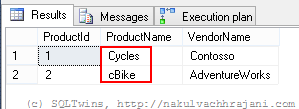
Now, attempt to query the table for all products whose names begin with the letter ‘c’ (small case). To do so, we need to temporarily COLLATE the column – dbo.Product.ProductName to a case sensitive collation (in my case, this is SQL_Latin1_General_CP1_CS_AS).

USE AdventureWorks2012;
GO
SELECT ProductId,
       ProductName,
       VendorName
FROM dbo.Product 
WHERE ProductName 
    COLLATE SQL_Latin1_General_CP1_CS_AS
    LIKE 'c%';
GO

An observation

As can be seen from the image below, desired results are obtained. However, if one has the actual execution plan opened up, an interesting observation can be made if we look at the properties of the SELECT operation.

Results of case-sensitive comparison

image

We can observe that SQL Server internally uses the CONVERT function with a style of 0. Per Books On Line (see references below), this indicates a binary to character conversion. This conversion is performed for all records in the table, which in-turn affects performance.

Conclusion

Because we have the overhead of applying a conversion on all rows of a particular table, this method should be used only when the column cannot be modified to permanently use a case sensitive collation and a business need exists to provide both case sensitive & insensitive search.

Further Reading

Until we meet next time,
Be courteous. Drive responsibly.

#0353 – SQL Server – Locate an object in a SQL Server Instance (using documented features)


A while back, I wrote a post on locating an object in a SQL Server instance (post #351). One of the items I received as part of the feedback was to implement the logic using documented (and therefore supported) features.

As you may know, I had used the sp_MSforeachDB system stored procedure in my earlier post. This is an undocumented procedure and therefore the recommendation is to assume that it is unsupported and not use it in production environments. In today’s post, I present before you a script that achieves the same objective (i.e. locate an object in a SQL Server instance), but using fully documented (and therefore fully supported) features.

Improvements over the script using sp_MSforeachDB:

  • Uses fully documented features
  • Does a comparison on both – the schema name and the object name
  • Search is only limited to user databases by default (system databases can be easily reintroduced by commenting out appropriate filter conditions in the query below)

The entire script is provided below for your reference:

USE master;
GO

SET NOCOUNT ON;

--Declarations
BEGIN
    --User to fill in
    DECLARE @schemaToSearch NVARCHAR(255) 
                            = N'dbo';
    DECLARE @objectToSearch NVARCHAR(255) 
                            = N'uspGetBillOfMaterials';

    --Internal variables
    DECLARE @databaseInformation TABLE 
                (DatabaseId INT NOT NULL,
                 DatabaseName NVARCHAR(255),
                 IsProcessed BIT NOT NULL
                );
    DECLARE @databaseId INT = 0;
    DECLARE @databaseName NVARCHAR(255) = N'';
    DECLARE @sqlStmnt NVARCHAR(1000) = N'';
END

--Fetch all user databases into temporary table variable
--for convenience
BEGIN
    INSERT INTO @databaseInformation (DatabaseId, 
                                      DatabaseName, 
                                      IsProcessed)
    SELECT sdb.database_id AS DatabaseId,
           sdb.name AS DatabaseName,
           0 AS IsProcessed
    FROM sys.databases AS sdb 
    WHERE CAST((CASE WHEN SUBSTRING(sdb.name,0,14) 
                          IN ('master',
                              'msdb',
                              'model',
                              'tempdb',
                              'ReportServer$') 
                          THEN 1 
                     ELSE sdb.is_distributor 
                END) AS BIT) = 0;
END

--Begin processing one database after another
WHILE EXISTS (SELECT dbi.DatabaseId 
              FROM @databaseInformation AS dbi 
              WHERE dbi.IsProcessed = 0
             )
BEGIN
    SELECT TOP 1
           @databaseId = dbi.DatabaseId,
           @databaseName = dbi.DatabaseName
    FROM @databaseInformation AS dbi
    WHERE dbi.IsProcessed = 0;

    --Build the statement to fetch the objectId of an object 
    --and then check for it's existence
    SET @sqlStmnt = N'USE ' + QUOTENAME(@databaseName) + N';
    DECLARE @objectId INT;
    SET @objectId = OBJECT_ID(''' 
                + QUOTENAME(@schemaToSearch) 
                + N'.' 
                + QUOTENAME(@objectToSearch) 
                + N''')
    IF EXISTS (SELECT *
               FROM sys.objects AS so
               WHERE so.is_ms_shipped = 0
               AND so.object_id = @objectId
             )
    BEGIN
        SELECT DB_NAME() AS DatabaseName;
    END;'

    --Execute the query
    --PRINT @sqlStmnt;
    EXEC sp_executesql @sqlStmnt = @sqlStmnt;

    --Mark the database as done
    UPDATE dbi
    SET dbi.IsProcessed = 1
    FROM @databaseInformation AS dbi
    WHERE dbi.DatabaseId = @databaseId
      AND dbi.DatabaseName = @databaseName; 

END
GO

Until we meet next time,
Be courteous. Drive responsibly.

#0352 – SQL Server – Working with Temporary Tables (L100) – Scope


In this post, I provide a Level 100 primer on the scope related considerations for local temporary tables.

While I have written about temporary tables a lot in the past (and the same has also been done by other writers), there are some questions that I keep encountering from the team or in various forums on the Internet which is why I am writing this post.

Temporary tables use the tempdb and come in two variants:

  1. Local Temporary Tables
    • As the name implies, they are local to the connection that created them
    • Therefore, if multiple connections request creation of a temporary table with the same name, each connection gets it’s own unique copy of the temporary table
    • The local temporary tables are implicitly deleted when the connection is closed
    • To create a local temporary table, prefix the desired table name with a single hash (#) mark, e.g. A local temporary table for employees might be named #Employee or #HumanResources
  2. Global Temporary Tables
    • These are global to the entire SQL Server instance and are therefore shared by all connections to the server
    • They are implicitly deleted when the last connection referencing them is closed
    • To create a global temporary table, prefix the desired table name with a double hash (##) mark, e.g. A global temporary table for employees might be named ##Employee or ##HumanResources

A demo on local temporary tables

The most important point that is missed out by most novice developers is that temporary tables are session specific. To briefly demonstrate this, allow me to follow the following steps:

  1. Open SQL Server Management Studio and launch two (2) query editor windows
    • In each window, connect to the same database and same SQL Server instance
  2. Run the following in window #1. This snippet creates a local temporary table and populates some records into it
--Window 01
USE AdventureWorks2012;
GO

--Create the local temporary table if it does not exist
IF OBJECT_ID('tempdb..#BasicEmployeeList','U') IS NULL
BEGIN
CREATE TABLE #BasicEmployeeList 
    ( BusinessEntityID INT          NOT NULL,
      JobTitle         NVARCHAR(50) NOT NULL,
      Title            NVARCHAR(8)      NULL,
      FirstName        NVARCHAR(50) NOT NULL,
      MiddleName       NVARCHAR(50)     NULL,
      LastName         NVARCHAR(50) NOT NULL
    );
END;
GO

INSERT INTO #BasicEmployeeList
    (BusinessEntityID,
     JobTitle,
     Title,
     FirstName,
     MiddleName,
     LastName
    )
SELECT p.BusinessEntityID,
       e.JobTitle,
       p.Title,
       p.FirstName,
       p.MiddleName,
       p.LastName
FROM Person.Person AS p
INNER JOIN HumanResources.Employee AS e
ON p.BusinessEntityID = e.BusinessEntityID;
GO
  1. Without closing window #1, Switch over to window #2
  2. Attempt to run the statement shown below
    • The system will encounter an error
USE AdventureWorks2012;
GO
SELECT bel.BusinessEntityID,
       bel.JobTitle,
       bel.Title,
       bel.FirstName,
       bel.MiddleName,
       bel.LastName
FROM #BasicEmployeeList AS bel;
GO

/* ERROR
Msg 208, Level 16, State 0, Line 1
Invalid object name '#BasicEmployeeList'.
*/
  1. The error is received because the temporary table was created as a local temporary table and is therefore inaccessible to other connections

Important points to note

  • Because temporary tables are persisted in the tempdb, the tempdb can see significantly large I/O operations if your application makes use of a lot of temporary storage
  • SQL Server gives Local Temporary tables an auto-generated name which is transparent to the caller to allow multiple connections to the use local temporary tables with the same name [Link]
  • Local temporary tables can be shared to referencing stored procedures as long as they use the same connection
    • This is documented in my post [Link]
  • Creating named constraints on temporary tables prevent them from being used concurrently
  • Temporary tables do not support:
    • Foreign key constraints [Links]
    • Triggers

Until we meet next time,

Be courteous. Drive responsibly.

#0351 – SQL Server – Locate an object in a SQL Server instance


Interacting with people on a SQL Server forum is always something that I look forward to. It gives me an insight into the challenges that are being faced out in the field – some of which I may have already encountered & addressed myself in the past, but thought it to be something trivial. A recent question was before me which prompted this post.

A friend of mine was involved in a knowledge transfer of a legacy product from one team to another. Documentation was insufficient and most of the product knowledge was in the brains of the people who had originally developed the system. One of the points covered in the transfer that all databases of that product would have a particular database object (a table or a stored procedure). If that object did not exist, the database was not a valid database for that product. The question therefore was:

“Given a SQL Server instance, is it possible to check for existence of a particular database object across all databases in the instance?”

The simple answer is yes.

However, the answer involves the use of a undocumented (and therefore unsupported) system stored procedure – sp_MSforeachdb.

USE master ;
GO
EXEC sp_MSforeachdb 
       N'USE ?;
         IF EXISTS (SELECT *
                    FROM sys.objects AS so
                    WHERE so.is_ms_shipped = 0
                      AND so.name = ''uspGetBillOfMaterials''
                   )
            SELECT ''?'' AS DatabaseName;' ;
GO

/*RESULTS

DatabaseName
------------------
AdventureWorks2012

*/

Disclaimer: Because of the use of unsupported system stored procedure, it is recommended that the script provided below is limited to use in the development and quality assurance environments only.

Further Reading

Until we meet next time,

Be courteous. Drive responsibly.