Tag Archives: #TSQL

Articles on T-SQL. This can be a script or a syntax element

#0350 – SQL Server – CREATE INDEX – DROP_EXISTING option and Msg 7999


Normally, when we need to perform maintenance operations on any database object as part of a database deployment, we would first check for it’s existence. If the object exists, the query would be required to first drop the object and then recreate it (or simply modify it).

For indexes, this would result in a script that is similar to the one shown below:

--Creating Indexes (the traditional/common way)
IF EXISTS (SELECT * 
           FROM sys.indexes AS si 
           WHERE si.name = 'ncidx_ProductName')
    DROP INDEX ncidx_ProductName ON dbo.Product;
GO

CREATE UNIQUE NONCLUSTERED INDEX ncidx_ProductName
       ON dbo.Product (ProductName);
GO

However, as I was reading the Books On Line the other day, I noticed an interesting option in the CREATE INDEX statement – the DROP_EXISTING option. Here’s an example demonstrating the usage of this option:

--Creating Indexes using the DROP_EXISTING option
CREATE UNIQUE NONCLUSTERED INDEX ncidx_ProductName 
    ON dbo.Product (ProductName) WITH (DROP_EXISTING = ON);
GO

DROP_EXISTING allows us to request the database engine to drop and rebuild the index with the new definition. However, the index must exist before the DROP_EXISTING can be used. If DROP_EXISTING is used with the CREATE INDEX statement for an index that does not exist, the following error is seen.

Msg 7999, Level 16, State 9, Line 2
Could not find any index named ‘ncidx_ProductName’ for table ‘dbo.Product’.

Summary

Although I am yet to use the DROP_EXISTING option in my maintenance operations, it does appear to be lucrative due to the reduced number of lines involved in recreating the index. A couple of points need to be kept in mind, though:

  • The index must be existing when the DROP_EXISTING option is used
  • We can use DROP_EXISTING when changing the definition of the index
  • Index type (clustered to non-clustered or vice-versa) cannot be changed when DROP_EXISTING is used

Further Reading

Until we meet next time,

Be courteous. Drive responsibly.

#0347 – SQL Server – Basics – A SELECT that does not fetch anything also does not SET anything


In today’s post, I go all the way back to the basics because of a logical bug I saw in production code recently.

It is always said to be a good practice to initialize variables within procedures so that you know what the default value is and what are valid and invalid values for a variable. For example, if the procedure does not have to deal with NULLs, then it is a good idea to initialize the variables as NULL so that a simple = NULL check is sufficient to tell whether we still have a default, invalid value or not.

The code below attempts to fetch the vacation hours for a given employee. The variables have default values defined, so it follows the variable initialization best practice mentioned above. In all probability, static code analysis/review would have never caught a logical bug hidden in the code below which raises it’s head when the code is run with an incorrect employee Id.

USE AdventureWorks2012;
GO

DECLARE @employeeVacationHours INT = -1;
DECLARE @employeeId INT;

--To be filled in by user
SELECT @employeeId = 777;

SELECT @employeeVacationHours = VacationHours
FROM HumanResources.Employee
WHERE BusinessEntityID = @employeeId;

IF (@employeeVacationHours < 0)
PRINT 'Employee has invalid vacation hours.';

SELECT @employeeVacationHours AS VacationHours;

/* RESULT:

VacationHours
-------------
-1

*/

In this case, the SELECT statement which is supposed to fetch the vacation hours for the employee will not return any records. Because of this, the variable will continue to preserve it’s value and will not reset to the default value or NULL.

A SELECT statement that does not fetch anything also does not SET anything.

The scenario mentioned here is a simplified one – in the production code, this logical bug caused the procedure to go down a completely different code path causing various other “random” issues.

The solution to this problem? In this example, it’s quite simple – change the initialization value for the @employeeVacationHours variable to NULL and then check for NULL after the SELECT operation is complete.

Until we meet next time,

Be courteous. Drive responsibly.

#0346 – SQL Server – Using CASE with a PRINT statement


Informational and alert messages during execution of a T-SQL script are the most preferred method to update the user on the progress of the task being executed. These messages are generated by the various PRINT statements embedded in the script.

Often there may be a requirement to display a particular message when a given set of conditions is met and another message otherwise. In such cases, I used to write a  standard IF…ELSE block and embed the PRINT statements within.

So, for example if the task at hand was to determine whether two numbers are equal or not, the traditional code would have been:

USE tempdb;
GO

--Traditional method
IF OBJECT_ID('dbo.proc_TraditionalNumberCompare','P') IS NOT NULL
DROP PROCEDURE dbo.proc_TraditionalNumberCompare;
GO

CREATE PROCEDURE dbo.proc_TraditionalNumberCompare
@intA INT,
@intB INT
AS
BEGIN
SET NOCOUNT ON;

IF (@intA - @intB ) = 0
PRINT 'Traditional Method - Both integers are the same.';
ELSE IF (@intA - @intB) > 0
PRINT 'Traditional Method - Integer A is greater than Integer B';
ELSE IF (@intA - @intB) < 0
PRINT 'Traditional Method - Integer B is greater than Integer A';
ELSE
PRINT 'Unreachable code!';
END
GO

--Tests
EXEC dbo.proc_TraditionalNumberCompare @intA = 5, @intB = 5;
GO
/* RESULT
Traditional Method - Both integers are the same.
*/

EXEC dbo.proc_TraditionalNumberCompare @intA = 2, @intB = 5;
GO
/* RESULT
Traditional Method - Integer B is greater than Integer A
*/

EXEC dbo.proc_TraditionalNumberCompare @intA = 5, @intB = 3;
GO
/* RESULT
Traditional Method - Integer A is greater than Integer B
*/

However, I recently realized that if the expression returns a string value, it can directly be used in a single PRINT statement, i.e. I can rewrite the logic to compare two integers shown above into a single statement as demonstrated below:

USE tempdb;
GO

IF OBJECT_ID('dbo.proc_NumberCompare','P') IS NOT NULL
DROP PROCEDURE dbo.proc_NumberCompare;
GO

CREATE PROCEDURE dbo.proc_NumberCompare
@intA INT,
@intB INT
AS
BEGIN
SET NOCOUNT ON;

PRINT CASE
WHEN (@intA - @intB) = 0
THEN 'Both integers are the same.'
WHEN (@intA - @intB) > 0
THEN 'Integer A is greater than Integer B'
WHEN (@intA - @intB) < 0
THEN 'Integer B is greater than Integer A'
ELSE 'Unreachable code!'
END;
END
GO

--Tests
EXEC dbo.proc_NumberCompare @intA = 5, @intB = 5;
GO
/*RESULT
Both integers are the same.
*/

EXEC dbo.proc_NumberCompare @intA = 2, @intB = 5;
GO
/*RESULT
Integer B is greater than Integer A
*/

EXEC dbo.proc_NumberCompare @intA = 5, @intB = 3;
GO
/*RESULT
Integer A is greater than Integer B
*/

I’m sure you will also find this flavour of implementing the PRINT statement useful. Do let me know your thoughts before you go.

Further Reading

Until we meet next time,

Be courteous. Drive responsibly.

#0345 – SQL Server – Distributing a result set by equal number of rows


Recently, a colleague brought an interesting query to me – the design for one of their modules required that records in a table be grouped into chunks of a specified integer value and each record within this group be assigned a number starting from 1. Hence, if I had 20 records in a table and the group size was 5 records, I would end up with 4 groups and the records would need to be numbered from 1-5 within each group.

Note here that I do not want a fixed number of groups (I can easily achieve this using NTILE). The groups can reach any number – what I need is a fixed number of elements within a group.

This post documents the first solution that came to my mind. While that particular deliverable is complete by the time I write this post, I look forward to hearing about other solutions/suggestions to achieve this requirement.

Creating the Test Scenario

To create a test scenario, I first create a simple test table and populate it with some test data. To make things interesting, I have inserted a prime number of records.

USE tempdb;
GO
SET NOCOUNT ON
--Safety Check
IF OBJECT_ID('#recordDistributionTest','U') IS NOT NULL
   DROP TABLE #recordDistributionTest;
GO
--Create the test table
CREATE TABLE #recordDistributionTest
       (rowNum INT IDENTITY(1,1),
        numVal AS (rowNum * 10)
       );
GO
--Insert 17 records into the test table
INSERT INTO #recordDistributionTest
DEFAULT VALUES;
GO 17

The solution

The solution that first came to my mind was to use the modulo operator (%) on the identity/row number value.

For the purposes of this example, I have used a @recordsInAGrop variable which is set to 5.

--Variable to hold the number of records in a group
DECLARE @recordsInAGroup INT = 5;
--Perform the grouping when fetching the records
SELECT rdt.rowNum AS RowNumber,
       rdt.numVal AS RecordValue,
       CASE WHEN (rdt.rowNum % @recordsInAGroup) = 0
            THEN @recordsInAGroup
            ELSE (rdt.rowNum % @recordsInAGroup)
       END AS RowNumberWithinGroup
FROM #recordDistributionTest AS rdt;
GO

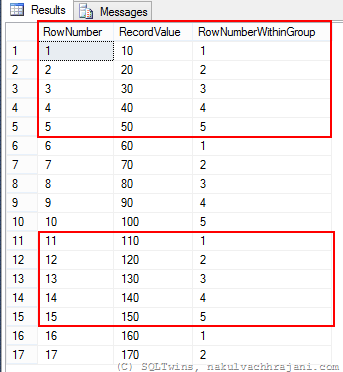
Following is the screenshot of the result obtained from this method.

image

As can be seen from the result, the first 15 records were grouped into 3 groups of 5 each. The last 2 records don’t belong to any group of the size specified in @recordsInAGroup variable and are therefore easily identifiable for further processing.

Do you have any suggestions on how to achieve this requirement in a much more efficient manner? Do drop in a line with your thoughts/suggestions.

Until we meet next time,

Be courteous. Drive responsibly.

#0343 – SQL Server – String values and effect on DateTime objects


One of the things that I was frequently told during my schooling was to initialize the variables that I use in my programs and scripts. The obvious benefit of having such mentors is that it has now become a matter of habit for me to initialize every variable in my SQL scripts.

One script required me to use the DATETIME datatype and I added an initialization to the variable explicitly. The script was simple enough and I had it all setup as pseudocode on my little notepad. However, in translating my thoughts from the notepad to the SQL script, I made a fatal error – I ended up initializing the DATETIME variable with a string. What follows is an account of the rather painful realization about the impact of my error.

Normally, when we attempt to assign a string value to a DATETIME variable, it results into an error.

DECLARE @myDate DATETIME;
SET @myDate = 'abcd';

SELECT @myDate;
GO

Immediately, we receive the following error:

Msg 241, Level 16, State 1, Line 2
Conversion failed when converting date and/or time from character string.

However, supplying valid dates as string does work.

--Passing valid dates as strings does work
DECLARE @myDate1 DATETIME, 
        @myDate2 DATETIME;
SET @myDate1 = '08/25/2014'
SET @myDate2 = 'August 25, 2014';

SELECT @myDate1 AS MyDate1, 
       @myDate2 AS MyDate2;
GO

/* RESULTS:
MyDate1                 MyDate2
----------------------- -----------------------
2014-08-25 00:00:00.000 2014-08-25 00:00:00.000
*/

However, I had initialized the variable with an empty, i.e. blank string. This does not return any error. However, it does do something different – something that might cause you to go around in circles unless maybe the code is reviewed by another set of eyes (which is what happened in my case) or after you take a much deserved break.

This is what I had done:

DECLARE @myDate DATETIME;
SET @myDate = '';

And the result was something that threw me off because all subsequent calculations that I had done on that particular date variable were returning incorrect results. After a couple of minutes and some help in reviewing the code again, I realized that:

Initializing a DATETIME, DATE or TIME variable with empty string sets it to 01/01/1900 (default value for DATE & TIME data-types).

Initialization with an empty string had initialized my date variable with the value – 00hrs on 01/01/1900, which is the default value for DATE & TIME data-types.

DECLARE @myDate DATETIME;
SET @myDate = '';

SELECT @myDate AS MyDate;
GO

/* RESULT
MyDate
-----------------------
1900-01-01 00:00:00.000
*/

NOTE: Attempting to use an empty string as default value for DATE and TIME data-types in the ISNULL() and COALESCE() functions also results into 01/01/1900 being returned as the default value.

Moral of the story

  • Always initialize all variables – it serves a dual purpose by both preventing and (as in this case) identifying potential errors
  • Be careful about the value being used for the initialization – it is possible that one may end up with an undesired effect of an incorrect initialization
  • It’s always good to have code reviews!

Further Reading

  • DATE and TIME data-types [MSDN Link]

Until we meet next time,

Be courteous. Drive responsibly.