
Tag Archives: Debugging

Articles related to Microsoft SQL Server debugging

#0434 – SQL Server – Stored Procedures – Results are not returned if the caller does not specify the OUTPUT clause


A few weeks ago, I wrote a piece on returning scalar values from a stored procedure using the OUTPUT clause. Shortly after, I got an interesting comment stating that the example outlined in the post was not working. There were no errors – it’s just that the output variables weren’t being set when the stored procedure was called.

Here’s the stored procedure which was shared in my earlier post.

USE [tempdb];
GO
IF OBJECT_ID('dbo.proc_AddNumbersWithMultipleOutputs','P') IS NOT NULL
BEGIN
    DROP PROCEDURE [dbo].[proc_AddNumbersWithMultipleOutputs];
END
GO
 
CREATE PROCEDURE [dbo].[proc_AddNumbersWithMultipleOutputs]
    @intA INT,
    @intB INT,
    @isSuccessfullyProcessed BIT OUTPUT, --Output variable #1
    @resultC                 INT OUTPUT  --Output variable #2
AS
BEGIN
    SET NOCOUNT ON;
 
    SET @isSuccessfullyProcessed = 0;
    SET @resultC                 = 0;
 
    BEGIN TRY
        IF ((@intA IS NULL) OR (@intB IS NULL))
            THROW 51000,'Input Parameters cannot be NULL',-1;
 
        SET @resultC = @intA + @intB;
        SET @isSuccessfullyProcessed = 1;
    END TRY
    BEGIN CATCH
        SET @isSuccessfullyProcessed = 0;
        SELECT ERROR_NUMBER(),
               ERROR_MESSAGE(),
               ERROR_SEVERITY(),
               ERROR_STATE();
    END CATCH
END
GO

And here’s the script that was not working as expected:

--In a separate window, run the following 
DECLARE @inputA  INT = 2; --Use NULL to throw exception
DECLARE @inputB  INT = 3; --Use NULL to throw exception
DECLARE @outputC INT;
DECLARE @processingState INT;
 
EXEC [dbo].[proc_AddNumbersWithMultipleOutputs] 
    @intA                    = @inputA,
    @intB                    = @inputB,
    @isSuccessfullyProcessed = @processingState,
    @resultC                 = @outputC;
 
SELECT @inputA          AS 'Input A', 
       @inputB          AS 'Input B',
       @outputC         AS 'Result', 
       @processingState AS 'IsTransactionSuccessfullyProcessed';
GO
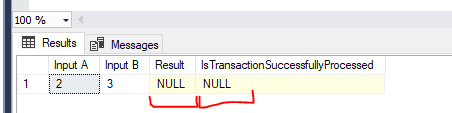
Screenshot showing no values were returned because OUTPUT parameter option was not specified.

If you carefully review the script, you will realize that @processingState and @outputC do not have the OUTPUT parameter specification. Without this specification, SQL Server treats it as a normal input parameter. Hence, no value was being returned. No errors should be expected as well. This behavior is the default and backward compatible.

Further reading

Until we meet next time,

Be courteous. Drive responsibly.

#0427 – SQL Server – Msg 8152, Level 16: Which column is causing “String or binary data would be truncated.”?


As a database administrator or developer, I’m quite sure that you’ve encountered the following error when working with your database queries in SQL Server.

Msg 8152, Level 16, State 30, Line 27
String or binary data would be truncated.

The statement has been terminated.

As is quite obvious by the text, this error occurs when you try to insert or update data that exceeds the maximum length of a column. While this error is common and quite straightforward to understand, it can be frustrating to troubleshoot – especially when you’re not sure which column is causing the issue (e.g. in the case of integrations or data imports).

In newer versions of SQL Server (2019 and above), the error message has become much more descriptive and I have found it very helpful to quickly identify and resolve the problem.

Let’s check it out with a code example. I am creating a test database and then changing the compatibility level of that database to 130 to simulate SQL 2016 equivalent behaviour. Then I will attempt to insert data (~42 characters) that exceeds the maximum length of the [SomeColumn1] column (25 characters).

SET ANSI_WARNINGS ON;
GO

USE [master];
GO
CREATE DATABASE [SqlTwinsDB];
GO
USE [master];
GO
ALTER DATABASE [SqlTwinsDB]
SET COMPATIBILITY_LEVEL = 130; --Simulating SQL 2016 on my SQL 2022 instance
GO


USE [SqlTwinsDB];
GO
--Safety Check
BEGIN
	IF OBJECT_ID('[dbo].[stringLengthError]','U') IS NOT NULL
	BEGIN
		DROP TABLE [dbo].[stringLengthError];
	END
END

--Declarations
BEGIN
	CREATE TABLE [dbo].[stringLengthError]([Id]          INT         NULL,
	                                       [SomeColumn1] VARCHAR(25) NULL,
										   [SomeColumn2] VARCHAR(25) NULL
						    		      );
END

--Run the test
BEGIN
	INSERT INTO [dbo].[stringLengthError] ([Id],
	                                       [SomeColumn1],
										   [SomeColumn2]
										  )
	VALUES (1, 
	        REPLICATE('nav',14), --14*3 = 42 characters, can't fit into [SomeColumn1]
			REPLICATE('nav',5)   --14*3 = 42 characters,  will fit into [SomeColumn2]
		   );
END

/* Expectation: Get the following error:

Msg 8152, Level 16, State 30, Line 27
String or binary data would be truncated.
The statement has been terminated.

Problem is: We don't know which column is generating the error, 
            unless we know the data and do some calculations.
*/

--Cleanup
BEGIN
	IF OBJECT_ID('[dbo].[stringLengthError]','U') IS NOT NULL
	BEGIN
		DROP TABLE [dbo].[stringLengthError];
	END
END
GO

The error message we get is quite generic and doesn’t provide any information about which column is causing the issue. This would mean that we would have to dump the data into another temporary table/file and begin the tedious task of comparing the lengths and finding which field/column is being hit with the offending data.

Msg 8152, Level 16, State 30, Line 27
String or binary data would be truncated.

The statement has been terminated.

Let us repeat this test with Compatibility Level set to 150 or higher (I will go with the default (160) for my version. Since the database is already created, I will simply change the compatibility level and try again.

SET ANSI_WARNINGS ON;
GO

USE [master];
GO
ALTER DATABASE [SqlTwinsDB]
SET COMPATIBILITY_LEVEL = 160;
GO

USE [SqlTwinsDB];
GO
--Safety Check
BEGIN
	IF OBJECT_ID('[dbo].[stringLengthError]','U') IS NOT NULL
	BEGIN
		DROP TABLE [dbo].[stringLengthError];
	END
END

--Declarations
BEGIN
	CREATE TABLE [dbo].[stringLengthError]([Id]          INT         NULL,
	                                       [SomeColumn1] VARCHAR(25) NULL,
										   [SomeColumn2] VARCHAR(25) NULL
						    		      );
END

--Run the test
BEGIN
	INSERT INTO [dbo].[stringLengthError] ([Id],
	                                       [SomeColumn1],
										   [SomeColumn2]
										  )
	VALUES (1, 
	        REPLICATE('nav',14), --14*3 = 42 characters, can't fit into [SomeColumn1]
			REPLICATE('nav',5)   --14*3 = 42 characters,  will fit into [SomeColumn2]
		   );
END

--Cleanup
BEGIN
	IF OBJECT_ID('[dbo].[stringLengthError]','U') IS NOT NULL
	BEGIN
		DROP TABLE [dbo].[stringLengthError];
	END
END
GO

This time, we still get the “String or binary data would be truncated” error, but with:

  • With a different message code (2628 instead of 8152)
  • A more verbose error which shows:
    • The field that is causing the error
    • The value that is being truncated
Msg 2628, Level 16, State 1, Line 31
String or binary data would be truncated in table 'SqlTwinsDB.dbo.stringLengthError', column 'SomeColumn1'. Truncated value: 'navnavnavnavnavnavnavnavn'.
The statement has been terminated.

Personally speaking, I find this to be a significant enhancement & a real time-saver when troubleshooting large data imports. Tip: If you’re working on an integration project and frequently encounter these types of errors, it may be worth considering upgrading your database engine to take advantage of this feature.

Sometimes, you may not even get this error and the truncation would happen silently. Do read my previous post https://nakulvachhrajani.com/2014/08/04/0341-sql-server-random-string-or-binary-data-would-be-truncated-errors-during-bulk-data-loads/ that talks about connection configuration parameters (more specifically, ANSI_WARNINGS) that may affect this behaviour.

Untill we meet next time,

Be courteous. Drive responsibly.

#0425 – SQL Server – Backup exists but doesn’t display on the restore window in SSMS. Why? How to fix?


Recently, I ran into a forum post where the ask was to figure out why a perfectly valid backup was not visible when attempting to restore it via the wizard in SSMS. Today, I will reproduce the issue, explain the root cause and provide the solution for the same.

Building the scenario

In one of the my test SQL Servers, I have a copy of the [AdventureWorks2019] sample database, which I have backed up using the following simple script.

USE [master];
GO
BACKUP DATABASE [AdventureWorks2019]
 TO DISK = 'C:\Program Files\Microsoft SQL Server\MSSQL14.SQL2K17\MSSQL\Backup\AdventureWorks2019.bak'
    WITH COMPRESSION;
GO

Now, to simulate the movement of the backup to a different machine, I created a new folder under my default “Documents” folder and placed the backup there.

Screenshot showing the placement of the target folder where the backup is placed

Reproducing the symptom

Restoring via SSMS

  1. Connect to the target SQL Server using SSMS
  2. Right-click on the “Databases” folder in the Object Explorer
  3. Choose to Restore a database
  4. Under “Source”, select the radio-option for restoring from a “Device”
  5. Use the ellipsis to open the “Select Backup Devices” window and open the File explorer by choosing “Add”
  6. Navigate to the folder where the backup has been placed
    1. Expected Result: We should be able to see the folder and the backup file
    2. Actual Result: The backup file is not seen (the folder may or may not be seen)
Screenshot showing that the backup exists, but it is not seen in the "Locate Backup File" window
Screenshot showing that the backup exists, but it is not seen in the “Locate Backup File” window

Restoring via T-SQL

While the UI keeps things a bit mysterious, attempting to restore via T-SQL does point us to the right direction.

USE [master];
GO
RESTORE DATABASE [AdventureWorks2019_Copy]
    FROM DISK = 'C:\Users\sqltwins\Documents\AdventureWorksBackup\AdventureWorks2019.bak';
GO

Here’s the error that we run into:

Msg 3201, Level 16, State 2, Line 3
Cannot open backup device 'C:\Users\sqltwins\Documents\AdventureWorksBackup\AdventureWorks2019.bak'. Operating system error 5(Access is denied.).
Msg 3013, Level 16, State 1, Line 3
RESTORE DATABASE is terminating abnormally.

Notice that the error clearly says – “Access is denied.

Root Cause

As highlighted by the results of the T-SQL script, SQL Server is actually running into a security problem. The operation is done under the context of the SQL Server instance service user (i.e. the user under which the SQL Server service runs).

Because the user doesn’t have access to the folder we just created, the service cannot see the files underneath.

Solution

The solution is to use the SQL Server Configuration Manager to figure out the user under which the SQL Server service runs.

Once the user is identified, provide access to the target folder to the user and the files should now be visible – both to SSMS and to T-SQL.

Screenshot showing the backup file is now visible once the SQL Server instance service has been granted to the folder

Further Reading/References:

Until we meet next time,

Be courteous. Drive responsibly.

#0424 – SQL Server – Null value is eliminated by an aggregate or other SET operation. – Why? How to fix?


I recently ran into a forum post where the poster wanted to know why they were getting the following warning during query execution:

"Null value is eliminated by an aggregate or other SET operation."

Having been asked this question a few times by a few of my office colleagues as well, I thought to write up a quick post on the reason behind this warning.

A quick test

The test below is simple – I am creating a sample test table which allows NULL values to be inserted. I am then trying to perform a simple aggregate function (SUM) over the NULL-able column. Upon checking the “Messages” tab, we see that no warning is returned.

USE [tempdb];
GO
SET NOCOUNT ON;

--Safety Check
IF OBJECT_ID('dbo.NULLAggregation','U') IS NOT NULL
BEGIN
    DROP TABLE [dbo].[NULLAggregation];
END
GO

--Create the test table
CREATE TABLE [dbo].[NULLAggregation] 
    ([Id]          INT           NOT NULL IDENTITY (1,1),
     [Value]       INT               NULL,
     [ValueString] VARCHAR(50)   NOT NULL,
     CONSTRAINT [pk_NULLAggregation] PRIMARY KEY ([Id])
    );
GO

--Insert the test data
INSERT INTO [dbo].[NULLAggregation] ([Value], [ValueString])
VALUES ( 1, 'One'),
       (10, 'Ten'),
       (22, 'Twenty-Two');
GO

--Perform the aggregation
--NOTE: No NULL values are in the table at this point
SELECT SUM([na].[Value]) AS [SumOfValues]
FROM [dbo].[NULLAggregation] AS [na];
GO

/****************************************
RESULT
-----------
SumOfValues
-----------
33
****************************************/

Now, I add a single record with a NULL value in the [Value] column and repeat the aggregation. While the result is the same, we have a warning in the “Messages” tab.

INSERT INTO [dbo].[NULLAggregation] ([Value], [ValueString])
VALUES ( NULL, 'One');
GO

SELECT SUM([na].[Value]) AS [SumOfValues]
FROM [dbo].[NULLAggregation] AS [na];
GO

/****************************************
RESULT
-----------
SumOfValues
-----------
33
Warning: Null value is eliminated by an aggregate or other SET operation.
****************************************/
A screenshot showing the warning encountered in SSMS when an aggregation operation is performed on a NULL value.
Warning encountered when aggregating on NULL values

The reason for the warning

To begin – this is just a warning and not an error. If your script/job is failing it is probably failing due to some other data condition OR as an indirect result of operating on NULL values.

The warning simply suggests that an aggregation operation is being done on a NULL value. If no NULL values are present in the dataset being evaluated, then the warning is not encountered.

Solutions

The important thing is to consider what is important for the business/domain.

  • If processing on NULL values are okay for the business/domain, then one of the following two (2) workaround can be applied:
    • The warning can either be ignored OR
    • Use the “SET ANSI_WARNINGS OFF” option for your query/procedure
  • If processing on NULL values is not acceptable for your business/domain, then
    • Either use a simple WHERE clause to remove the records with NULL values from the aggregation
    • Use input validations in the application code and NOT NULL checks in the database to stop the NULL values from being entered by the users

NOTE: If you do decide to use the “SET ANSI_WARNINGS OFF” option, please do so with caution. It can have unintended consequences with string operations as well (https://docs.microsoft.com/en-us/sql/t-sql/statements/set-ansi-warnings-transact-sql?view=sql-server-ver15)

I trust you found this post useful.

Until we meet next time,

Be courteous. Drive responsibly.

#0421 – SQL Server – SSIS – Wild card search to find if a file exists in a folder or directory


I recently answered a question on a forum which I believe will be useful to many of the readers in the audience.

SSIS packages are widely used for data import from and export to files. One of the main tasks in this situation would be to check if files with certain kinds of names exist in a particular folder or directory, i.e. basically perform a wild-card search in a directory.

The solution

This can be achieved by using the EnumerateFiles() method of the System.IO.Directory class in the SSIS Script task. Here’s the sample package:

In a folder, I have a set of files, some with similar names (which we will search from the SSIS package).

Files existing in the directory to be searched

The SSIS package has two (2) variables:

Variable NameConfiguration on the Script TaskDescription
SearchPathReadOnly, InputThis is the path to be searched
SearchPatternReadOnly, InputPattern to be searched
FileExistsReadWrite, OutputA boolean indicating downstream processes whether files were found or not
Table 1: Variables on the SSIS package
Screenshot showing the variables and their configuration on the script task

The script is a quite simple implementation as below:

public void Main()
{
    // SQLTwins: SSIS: Blog #0421

    string searchPath = Dts.Variables["User::SearchPath"].Value.ToString();
    string searchPattern = Dts.Variables["User::SearchPattern"].Value.ToString();

    System.Collections.Generic.List<string> searchResults = System.IO.Directory.EnumerateFileSystemEntries(searchPath, searchPattern).ToList();

    if (searchResults.Any())
    {
        Dts.Variables["User::FileExists"].Value = true;
    }

    Dts.TaskResult = (int)ScriptResults.Success;
}

Ensure that you have the following directive in the “namespaces” section of your script:

using System.Linq;

Here’s the script in action:

Screenshot showing the script in debug mode indicating that files were found matching the pattern.

As you can see, the script can help perform a wild-card search in a given folder or directory.

Further Reading:

  • File System errors when trying to move and rename a file [Blog Link]
  • Adding Date & Time to file names after processing [Blog Link]
  • VSTA Errors when working with SSIS packages [Blog Link]
  • System.IO.Directory.EnumerateFiles [MSDN Link]

Until we meet next time,

Be courteous. Drive responsibly.