Tag Archives: Tips

General Microsoft SQL Server tips

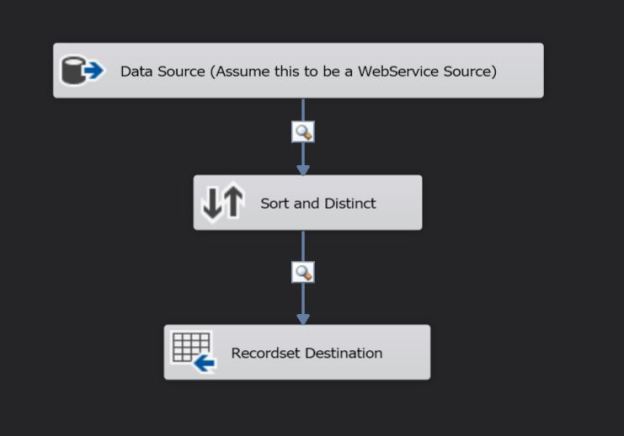
Overview of the sample SSIS package using the SORT operator

#0398 – SQL Server – SSIS – Performing a DISTINCT using the SORT transformation


Developing SSIS packages is quite easy – it’s mostly drag and drop and some minor configuration. Choosing the right transformations and components and making them work optimally is a task that is heavily dependent upon the use case at hand.

Normally, when working with relational data sources, I am averse to using the SORT transformation within a data flow, because it is a blocking transformation. Blocking transformations not only consume client memory, they also act as roadblocks in what should be an uninterrupted data pipeline. The performance tip (!) therefore is to prefer that sorting, if required, is done as part of the data source query itself so that the data pipeline gets presorted data.

However, presorting of data may not be possible in all cases. For example, if you are receiving data from a web-service, XML data source or any other 3rd party custom component. A SORT transformation becomes essential in such scenarios, but one of the areas where I have seen most people stumble upon is that a custom query is later used to remove unnecessary records from the set. The custom query is not required in most cases, and I will be demonstrating how to use configure the SORT transformation to also perform a DISTINCT.

Demo

Assume that:

  • You just need a list of unique patrons who visited a local library this year in order of their registration Id for sending out some promotional mails
  • The promotions need to be sent irrespective of the visit date and number of visits within the year
  • The input (log of library visits) is coming from a web-service of some sort over which you as an integration team member have no control over
  • Following is a sample of the test data that comes over from the web-service

NOTE: For the purposes of this demo, I will use a T-SQL SELECT to generate my test data, but I would request the reader to assume that the data is coming from a non-relational source.

SELECT LibraryVisitLog.PatronId,
       LibraryVisitLog.PatronName,
       LibraryVisitLog.VisitDate
FROM (VALUES (1201,'John Doe',  '2017-01-05'),
             (1180,'John Smith','2017-01-05'),
             (1201,'John Doe',  '2017-01-06'),
             (1201,'John Doe',  '2017-01-07'),
             (1201,'John Doe',  '2017-01-08'),
             (1201,'John Doe',  '2017-01-09'),
             (1201,'John Doe',  '2017-01-10'),
             (1280,'Jane Doe',  '2017-01-10'),
             (1201,'John Doe',  '2017-01-11'),
             (1201,'John Doe',  '2017-01-12'),
             (1210,'Jack Smith','2017-01-12'),
             (1201,'John Doe',  '2017-01-13'),
             (1201,'John Doe',  '2017-01-14'),
             (1180,'John Smith','2017-01-14')
     ) AS LibraryVisitLog (PatronId, PatronName, VisitDate)
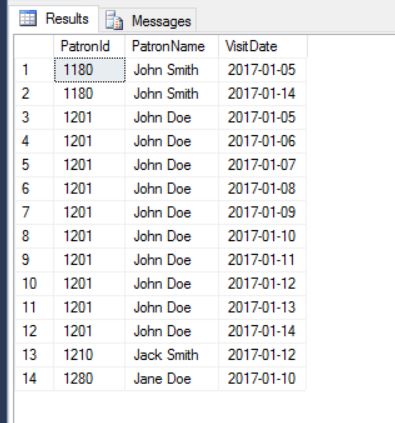
Sample Test Data to be used for the demo

Sample Test Data

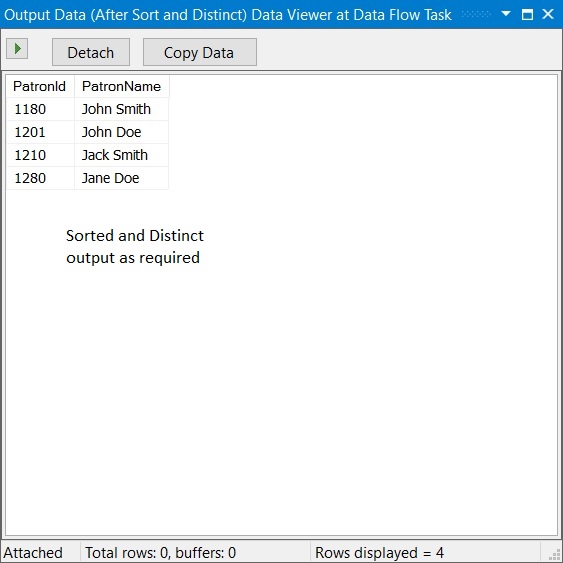
We only want the information about the following 4 (four) unique patrons ordered by their Id down the pipeline.

Patron Id Patron Name
1180 John Smith
1201 John Doe
1210 Jack Smith
1280 Jane Doe

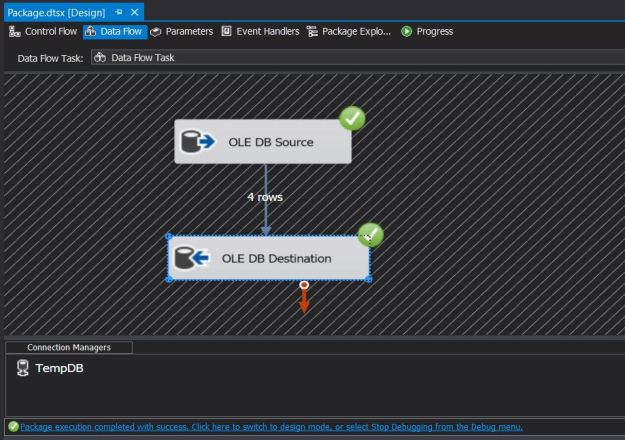
Configuring the SSIS package to achieve this is quite simple. As shown in the image below, I have a SORT transformation between my data source and target.
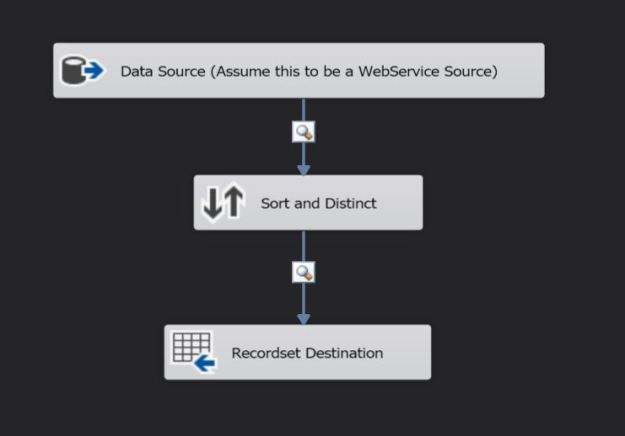
Overview of the sample SSIS package using the SORT operator

Overview of the demo SSIS package

The SORT transformation is configured to:

  • Ignore the VisitDate (as established in the requirements above)
  • SORT based on the PatronId
  • Pass the PatronName through the pipleline
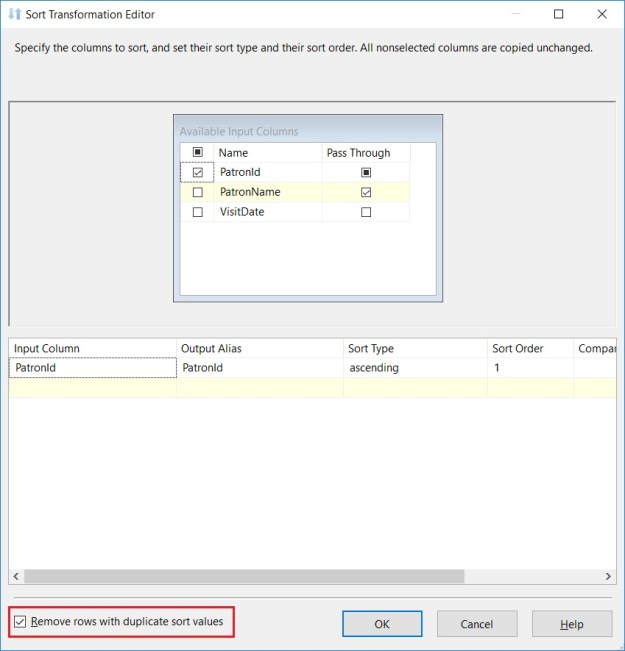
Configuring the SORT operator to perform a DISTINCT on the output rows

Configuring the SORT operator to perform a DISTINCT on the output rows

In addition, notice that I have checked the checkbox “Remove rows with duplicate sort values” in the bottom left corner. This switch controls whether the transformation copies duplicate rows on the transformation output or creates a single, unique entry for all duplicates.

To actually see the data flowing through the pipeline, I have enabled DataViewers on each stage of the data flow. You can see the actual data flowing through the pipeline in the screenshots provided below:
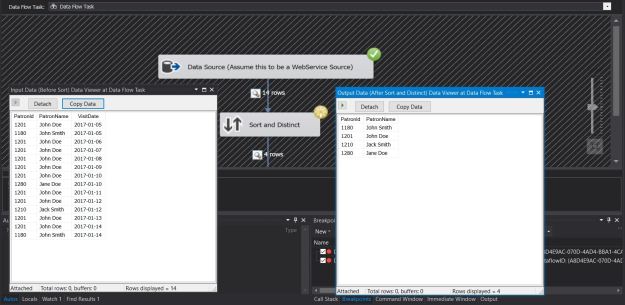
Demonstrating the ability of a SORT transformation to perform a DISTINCT on the data
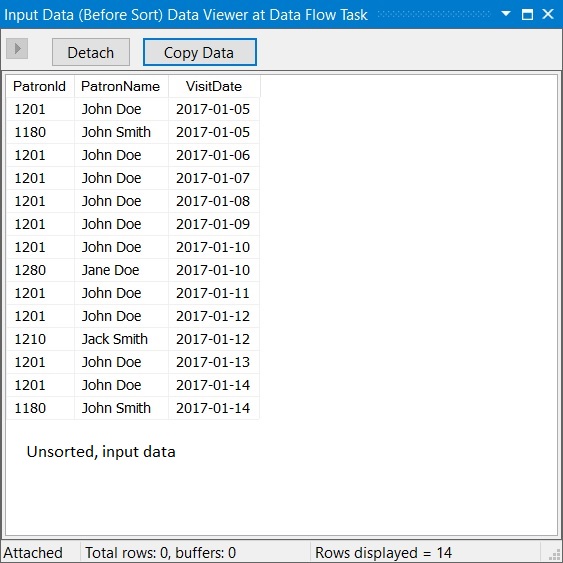
Demonstrating the ability of a SORT transformation to perform a DISTINCT on the data

0398-image05

Data Viewer showing input data

0398-image06

Data Viewer showing sorted and Distinct data

Summary

With respect to the SORT operator and achieving a balance between the performance and limitations of the data sources used by an SSIS package:

  • It is a best practice to pre-sort the data at the data source before sending it across a data flow pipeline
  • In case pre-sorting is not possible, but sorting is required, one can use the SORT transformation
  • Leverage the SORT transform to filter out unique records from the sorted output – custom logic is not required to do so

Further Reading

Until we meet next time,

Be courteous. Drive responsibly.

Showing the use of OLE DB fast load options when loading data

#0397 – SQL Server – SSIS – OLE DB Destination – SEQUENCE can be used only with fast load options


Traditionally, sequential numbers in a database system were managed by the use of IDENTITY columns. SQL Server 2012 saw the advent of the SEQUENCE object, which can be used to generate a sequence of numeric values according to a user-defined specification. Recently, I was working on an SSIS package which used the OLE DB transformation to load data into a table where one of the columns was populated by the SEQUENCE object. During the development of this  package, I ran into an interesting issue.

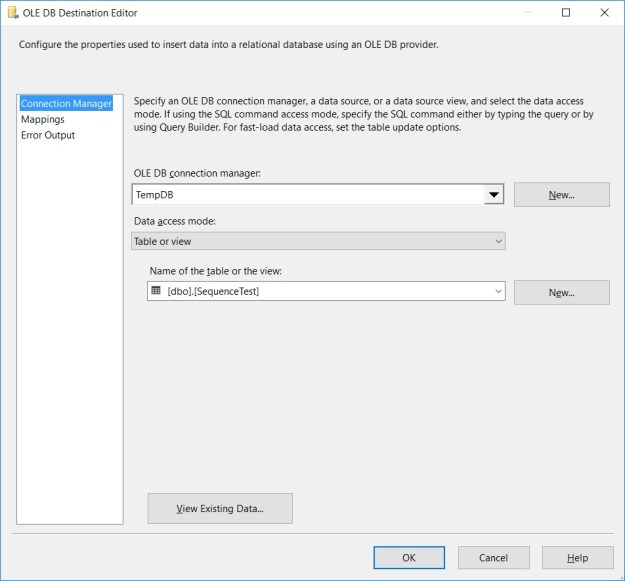
Standard load options of the SSIS OLE DB destination throw an error when inserting data into a table where SEQUENCE is used.

The workaround is quite simple – the OLE DB fast load options. Allow me to walk through a sample demonstrating this issue and the workaround.

Assume that we have an extremely basic sample SEQUENCE object which  starts at 1 and increments by 1. This SEQUENCE is then used as a default value for one of the columns in our test table.

USE [tempdb];
GO
--Safety  Check
IF OBJECT_ID('df_RecordId','D') IS NOT NULL
BEGIN
    ALTER TABLE dbo.SequenceTest 
        DROP CONSTRAINT df_RecordId;
END
GO

IF OBJECT_ID('dbo.RecordIdSequence','SO')  IS NOT NULL
BEGIN
    DROP SEQUENCE dbo.RecordIdSequence;
END
GO

IF OBJECT_ID('dbo.SequenceTest','U') IS NOT NULL
BEGIN
    DROP TABLE dbo.SequenceTest;
END
GO

--Create the sequence first
CREATE SEQUENCE dbo.RecordIdSequence
    START WITH  1
    INCREMENT BY 1;
GO

--Use this SEQUENCE on a default constraint
--associated with one of the columns in the table
CREATE TABLE dbo.SequenceTest 
    (RecordId INT NOT NULL 
              CONSTRAINT df_RecordId DEFAULT
              NEXT VALUE FOR dbo.RecordIdSequence,
     RowValue VARCHAR(50)
    );
GO

My SSIS package has nothing else other than a simple Data-Flow Transformation with 1 (one) OLE DB source and 1 (one) OLE DB destination.

The OLE DB source uses the following query to generate the test data.

SELECT t.RowValue
FROM (VALUES ('One'),
             ('Two'),
             ('Three'),
             ('Four')
     ) AS t (RowValue)

The OLE DB destination uses the standard (non fast-load) configuration as shown in the screenshot below.

Showing use of the SSIS OLE DB destination standard table load configuration

OLE DB standard table load configuration

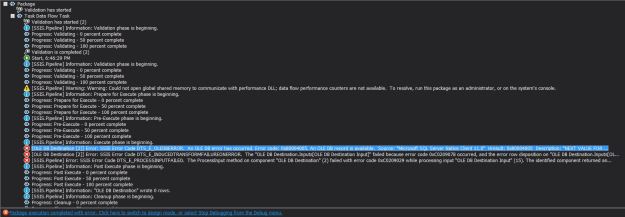
Running this SSIS package results in an error. The error text is provided below.

[OLE DB Destination [2]] Error: SSIS Error Code DTS_E_OLEDBERROR. 
An OLE DB error has occurred. Error code: 0x80004005.
An OLE DB record is available. 
Source: "Microsoft SQL Server Native Client 11.0" 
Hresult: 0x80004005 
Description: 
"NEXT VALUE FOR function cannot be used if ROWCOUNT option has been set, 
or the query contains TOP or OFFSET. ".
SSIS table load error when using OLE DB standard load into a table with the SEQUENCE object

SSIS table load error when using OLE DB standard load into a table with the SEQUENCE object

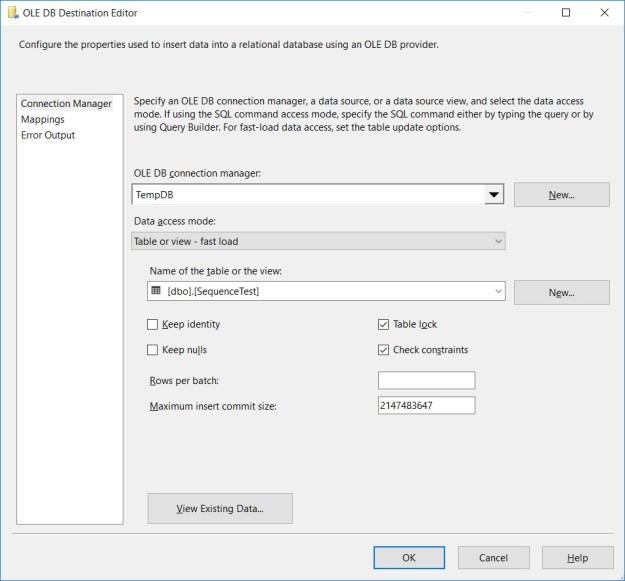
To resolve the error, all we need to do is to  change the OLE DB destination to use fast load options, by choosing “Table or View – fast load” as the “Data access mode“.

Showing the use of OLE DB fast load options when loading data

OLE DB Fast load options

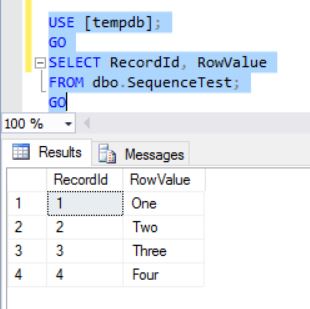
By making this small change, the SSIS package runs successfully, and data is also successfully inserted into the table.

0397-oledb_fastloadconfigurationsuccess0397-oledb_fastloadconfigurationsuccess2

Further Reading

Until we meet next time,

Be courteous. Drive responsibly.
#0396 – SQL Server – SSIS – Move and rename a file – “Could not find part of the path.” File System Task error


When working with disconnected sources or remote systems in SSIS, source data is often received in the form of files. A common requirement is to rename the file once the data import/processing is completed.

I looked at the File System task in my previous post. The file system task appears to be the best way to implement this requirement. However, we run into something that is unexpected:

The “Move File” operation moves a file from one folder to another. It does not rename the file.

Basic Scenario

Let me leverage the same example as I had in my previous post. I have a set of files in a folder and an SSIS package that is configured to rename the files.

Folder with input files which need to be renamed once processing is complete

Folder with input files which need to be renamed once processing is complete

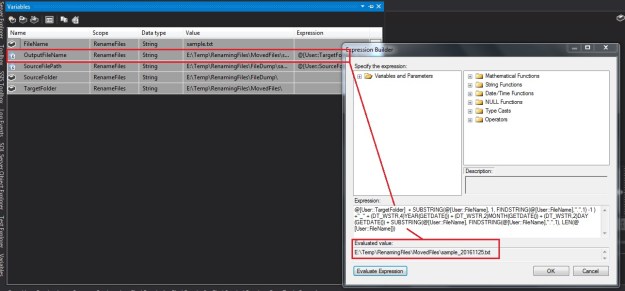
The destination file name comes from an expression that uses basic string concatenation to achieve the required target file name. The expression used in the destination file name variable is provided below.

@[User::SourceFolder] + 
SUBSTRING(@[User::FileName], 1, FINDSTRING(@[User::FileName],".",1) -1 ) + (DT_WSTR,4)YEAR(GETDATE()) + (DT_WSTR,2)MONTH(GETDATE()) + (DT_WSTR,2)DAY(GETDATE()) + 
SUBSTRING(@[User::FileName], FINDSTRING(@[User::FileName],".",1), LEN(@[User::FileName]))
Variable to populate the new name for the output file using an Expression

Variable to populate the new name for the output file using an Expression

Move File Operation

The File System Task in this package has been designed to use variables as the source and destination file names. The File System task is configured to perform a “Move File” operation.

0396-sqltwins-filesystemtask-configured-for-move-file-operation

File System Task in the “Move File” configuration

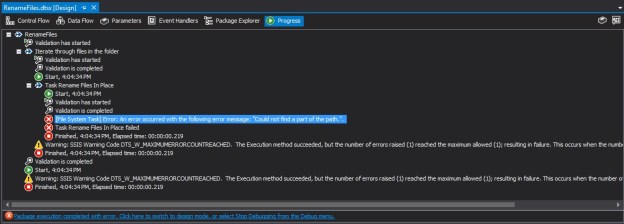
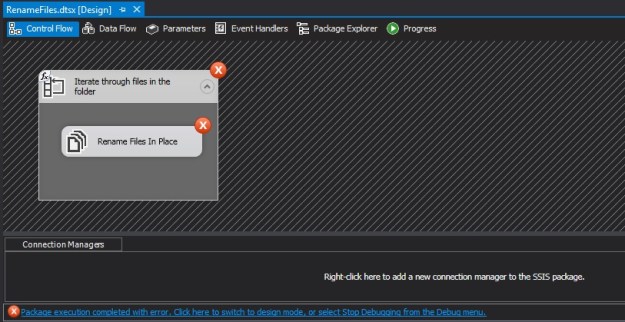
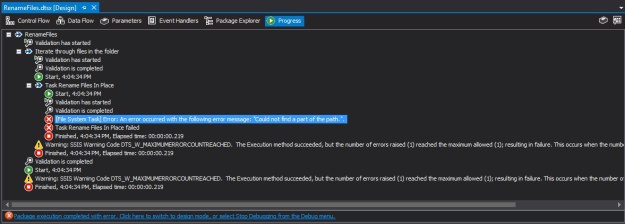
Upon running the SSIS package, no files are processed and we run into an error.

0396-sqltwins-filesystemtask-move-file-configuration-error

Execution Error when running the File System Task

0396-sqltwins-filesystemtask-move-file-configuration-error-details

“Could not find a part of the path.” error in the File System task “Move File” configuration

Looking at the error in detail, we see that the error is:

Could not find a part of the path.

Using the Rename File configuration

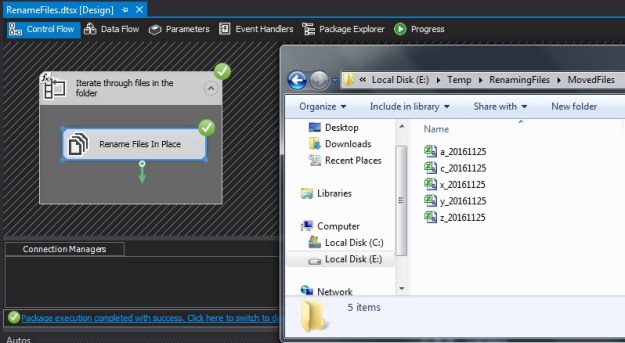
If we change the operation type to the “Rename File” configuration, we can see that the movement is successful.

File System Task configuration using

File System Task configuration using “Rename File” mode where input & output file names are supplied via variables

0396-sqltwins-result-of-renamefile-configuration

Moving files using File System task with “Rename File” operation

Behind the scenes

So, why is the File System task not behaving as expected? If the File System configuration is set to “Move File”, why did the files not move to the target folder?

The reason is quite simple: “Move File” only moves a file – it cannot rename a file during the movement of the file.

In  short, one has to configure the File System task in a “Rename File” configuration if a file has to be renamed – irrespective of whether the rename is in-place or in a different folder.

Until we meet next time,

Be courteous. Drive responsibly.
#0395 – SQL Server – SSIS – Adding date and time to a file name after processing


As we have been discussing over the last couple of weeks, moving data from a “source” to a “destination” is the crux of SSIS. The data source can be literally anything – a SQL Server  database, a web-service, a script, an XML or even a conventional delimited file.

Picking up files from a folder and processing them is one of the most common use-case that I have seen. In order to avoid processing the same file over and over again, the most common requirement is to append the file name with a date-time value. In this post, I will provide an expression I use to achieve this goal.

Appending a Date/Time and renaming a file in SSIS

The easiest way to append a date/time value to a file name and renaming the file in SSIS is via SSIS expressions.

Put every simply – an expression is a formula, a combination of variables, literals and operators that work together and evaluate to a single value.

We can use the following expression to yield a date value:

SUBSTRING(@[User::FileName], 1, FINDSTRING(@[User::FileName],".",1) -1 ) + (DT_WSTR,4)YEAR(GETDATE()) + (DT_WSTR,2)MONTH(GETDATE()) + (DT_WSTR,2)DAY(GETDATE())

This can then be appended to the file name and a simple File System Task can rename the file for us on the file system. Let’s see this in action with an example.

Demo

Assume a scenario where I have a set of files in a folder, and I need to do some processing on them. After processing, I need to update the file names with the date. For the sake of brevity of this example, I will not be performing any other operation on the files other than renaming them.

My folder containing the input files looks like this:

Folder with input files which need to be renamed once processing is complete

Folder with input files which need to be renamed once processing is complete

Now, I create an SSIS package that contains a simple For Each file iterator and a File System task.

For Each Loop configuration

The For Each Loop (configured as a file iterator) uses an expression populated by a variable to get the source directory information.

The file name and extension is fetched into a variable which will be used during the processing and subsequent renaming.

0395-sqltwins-overall-package

Overall package configuration showing the For Each File Iterator

0395-sqltwins-foreachloop-collection-configuration

For Each Iterator – Collection configuration using a variabel for the source directory

0395-sqltwins-foreachloop-fetching-file-name

Fetching the individual file name & extension into a variable

Now, I create a new user variable “OutputFileName” and use the expression below to generate the output file name. The expression has essentially 3 distinct parts:

  1. Fetch the file name (without the extension)
  2. Append the date to this string
  3. Fetch the file extension and append to the modified/new file name
@[User::SourceFolder] + 
SUBSTRING(@[User::FileName], 1, FINDSTRING(@[User::FileName],".",1) -1 ) + (DT_WSTR,4)YEAR(GETDATE()) + (DT_WSTR,2)MONTH(GETDATE()) + (DT_WSTR,2)DAY(GETDATE()) + 
SUBSTRING(@[User::FileName], FINDSTRING(@[User::FileName],".",1), LEN(@[User::FileName]))
Output File Path expression

Output File Path expression

This variable is now used in the configuration of the file system task which is responsible for renaming the file.

File System Task configuration

The file system task is an extremely flexible task component in SSIS. It can operate on the file system not only by using file connections but also on the basis of variables! For our problem, we will leverage this flexibility of the File System task.

As can be seen from the screenshot below, my File System task has been configured as follows:

  • Source File Path is a variable
  • Destination File Path is a variable
  • File Operation type = “Rename File”

The “Rename File” operation renames the file specified by the old file path and renames it to the name specified by the new file path.

File System Task configuration using “Rename File” mode where input & output file names are supplied via variables

Once the package is executed, we can see that the files in the source folder are now updated as expected.

Source Folder with the File Names updated as expected

Source Folder with the File Names updated as expected

Further Reading

Until we meet next time,

Be courteous. Drive responsibly.
High-level usage of the File Ordering script task

#0394 – SQL Server – SSIS – ForEach Loop – Controlling processing order


One of the SSIS related questions that I see often in the forums is around the ability to control the sequence in which a For Each Loop processes the files from a directory. When performing data movement as part of an ETL or an integration, it may be required to work asynchronously. The “sender” of the data may place the files in a folder for the data processing to pickup. These files generally contain ordered data that needs to be loaded in a specific sequence.

The problem is that the SSIS For Each Loop container does not have the provision that allows a user to specify the order in which the files are to be processed. Today, I present one of the workarounds that I came up with (there may be others, and I would be very interested to know what do you prefer in these scenarios).

Environment Prep

To demonstrate the ordered loading of files, I created a set of simple files  and a table to which I will be adding the data read from these files.

USE [tempdb];
GO

IF OBJECT_ID('dbo.ImportedData','U') IS NOT NULL
BEGIN
    DROP TABLE dbo.ImportedData;
END
GO


CREATE TABLE dbo.ImportedData 
   (RecordId           INT          NOT NULL IDENTITY(1,1),
    ProcessedFileName  NVARCHAR(255) NOT NULL,
    RecordValue        NVARCHAR(100)     NULL,
    ProcessedDate      DATETIME     NOT NULL,
    CONSTRAINT pk_ImportedData PRIMARY KEY CLUSTERED (RecordId, ProcessedDate)
   );
GO

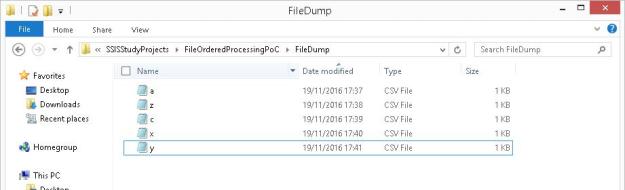
To demonstrate the fix, I will not be processing the files in order of their file names, but I will instead be processing them in order of  the date on which they were last saved. The screenshot below shows the order in which files will be processed.

Folder showing files to process in the required non-alphabetical order

Folder showing files to process in the required non-alphabetical order

Core Logic – Identify the Order of the Files to Process

The For Each container is just a mechanism to loop through a set (of objects/files/records). It does not have the provision to control the order in which the set is to be iterated through.

Hence, the workaround that I came up with was to supply a pre-ordered set to the For Each container. I therefore used a script task to order the filenames in a recordset object which I will pass to the For Each container.

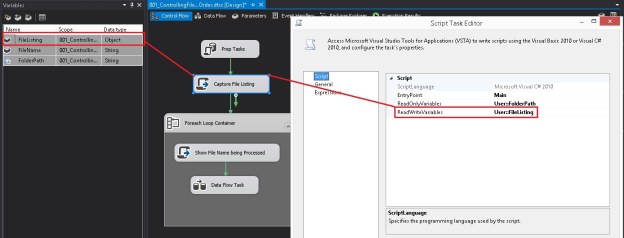
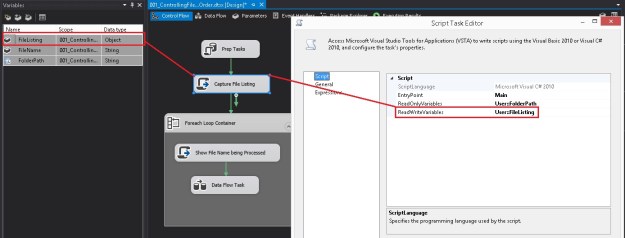
As shown below, I pass the path to the folder where the files are located, and accept the sorted list into an object.

High-level usage of the File Ordering script task

High-level usage of the File Ordering script task

The script used within the script task which is also the heart of this solution is provided below.

public void Main()
{
    // TODO: Add your code here
    DirectoryInfo di = new DirectoryInfo((string)Dts.Variables["User::FolderPath"].Value);
    List<string> files = new List<string>();

    foreach (var fi in di.EnumerateFiles().OrderBy(t=>t.LastWriteTime))
    {
        files.Add(fi.FullName);
    }

    Dts.Variables["User::FileListing"].Value = files;

    Dts.TaskResult = (int)ScriptResults.Success;
}

Process the File

The  next stage is simply to process the file.

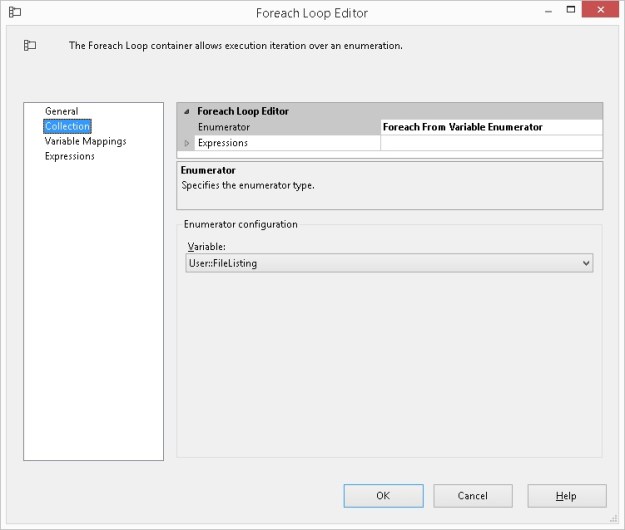
  • The sorted set of files is iterated upon by the For Each container
  • I have a script task that simply prints out a message box with the file being processed currently
  • The data flow task simply reads from the file and writes to a conventional OLE DB destination

Screenshots showing these bits of the configuration are provided below.

0394-sqltwins-ssis-foreachcontainer

For Each Loop Iteration Configuration

0394-sqltwins-ssis-foreachcontainer2

For Each Loop File Name configuration

0394-sqltwins-ssis-dfd_fileconnection

Setting the file connection based on the File Name set by For Each Iterator

If I execute the SSIS package and then query the destination table, we see that the files were indeed ordered in the expected order.

USE [tempdb];
GO
SELECT * 
FROM dbo.ImportedData 
WHERE RecordValue LIKE '%1%';
GO
0394-sqltwins-ssis-output

Output of script to confirm that data was loaded in the required sequence

Further Reading

Until we meet next time,

Be courteous. Drive responsibly.